PropNex Picks
|December 02,2025What's Next For 38 Oxley Rd, SG's Most Debated Address?
Share this article:

What should a nation do when its most symbolic address becomes its most complex policy question? 38 Oxley Road isn't just a house - it's a reference point that forces Singapore to confront what we truly value: legacy, progress, privacy, or principle.
It was the residence of the late Mr Lee Kuan Yew, a place where decisions that shaped modern Singapore were crafted far from public view. Today, the debate over its fate plays out in the court of public opinion. Should the house stand as a national reminder of where we came from? Or should Singapore honour Mr Lee's personal wish for demolition - a request rooted in his lifelong belief that we must never cling blindly to the past?
The issue remains sensitive, multi-layered, and far from straightforward. Because whatever happens next will define not just the site, but the planning priorities Singapore intends to uphold.
The idea of turning 38 Oxley Road into a national monument resurfaces regularly - and for good reason. This isn't just a conservation debate; it raises questions about how Singapore evaluates heritage, personal wishes, and land-use priorities. It also sits within a broader public discussion that has included differing views expressed by members of the founding family, underscoring how sensitive and multi-layered the issue remains.
Pros of preserving it as a monument
1. Historical and cultural significance: This home was more than a residence; it was an informal command centre during Singapore's most critical decades. Negotiations, drafts of speeches, and key discussion took place within its modest walls. Preserving it would allow future generations to step into the physical space where a large part of Singapore's political consciousness was shaped.
2. Educational potential: Beyond being a static monument, the site could serve as a living classroom. Students, historians, and young leaders could immerse themselves in curated narratives about early nationhood, political discipline, and the realities of leadership that shaped modern Singapore.
3. Tourism appeal: Cities around the world preserve the homes of founders, revolutionaries, presidents, and thinkers. 38 Oxley could join this global tradition - drawing visitors interested in Singapore's unique development story and boosting heritage tourism.
4. Cultural identity anchor: At a time when cities evolve rapidly, physical links to the past help ground national identity. Preserving the Oxley home could offer a rare sense of continuity.
To put this in perspective, several countries have chosen to preserve the personal residences of their founding figures as national touchstones. The Churchill War Rooms in London allow visitors to walk through the very space where Britain planned its wartime strategy - illustrating how built heritage can serve educational and historical functions when preserved thoughtfully.
Cons of turning it in a monument
1. Respecting personal wishes: According to publicly available statements and past communications, Mr Lee expressed clearly - multiple times - that he wished for the house demolished. Going against this risks creating the exact kind of posthumous glorification he wanted Singapore to avoid.
2. Practical limitations: The house is old, structurally fragile, and would require extensive stabilisation work. Maintenance, restoration, staffing, and security would demand ongoing financial commitments.
3. Neighbourhood impact: Oxley Road is a quiet, exclusive enclave. Increased foot traffic, tour buses, and heightened security may compromise the privacy of residents and alter the neighbourhood's character.
4. Risk of over-commercialisation: Turning the residence into a public attraction may inadvertently reduce the dignity and simplicity that Mr Lee embodied. There is a thin line between commemoration and public display - and crossing it could cheapen the site's meaning.
5. Potential distortion of narrative: A monument may unintentionally elevate an individual above the collective founding team, which contradicts Singapore's ethos of shared nation-building.
Before moving on, one thing is clear: whether preserved or not, treating 38 Oxley Road as a monument demands a level of national self-reflection few sites ever require.
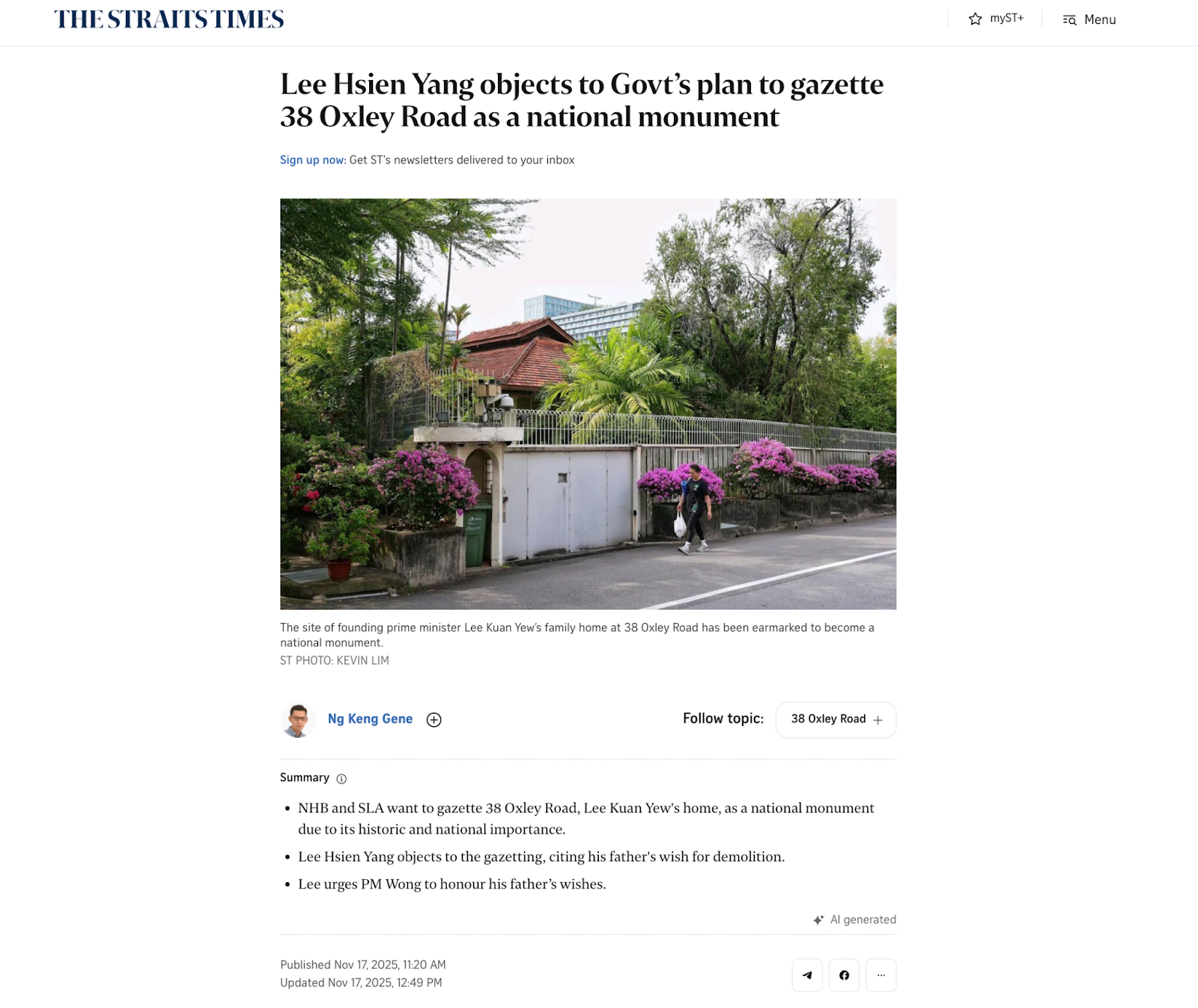
This debate has also surfaced within the founding family itself. In public statements, Mr Lee Hsien Yang has objected to any move to gazette the house as a national monument, reiterating that such a move would contradict his father's explicit wishes. His stance adds another layer of complexity to an already sensitive issue - highlighting how the question of preservation is not just political or architectural, but deeply personal.
And if the country chooses not to enshrine it, the question becomes - what then?
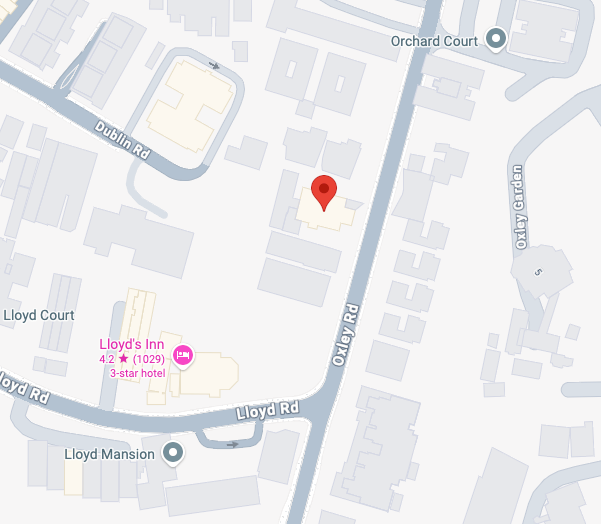
If authorities were ever to decide not to designate the house as a monument, the question becomes even sharper: should Singapore reshape the land entirely and move forward, or attempt to retain fragments of the past in a new form? Its prime central location and historical importance make the site one of the most consequential pieces of land in modern urban planning - a crossroads where sentiment, strategy, and legacy collide. What happens here will speak volumes about how Singapore chooses to grow.
Option 1: A public park
Transforming the site into a public green space may offer a middle ground.
Pros
- Honours legacy without preserving the physical house: A park can provide a serene, reflective environment that aligns with Mr Lee's preference for demolition while still acknowledging the site's importance.
- Enhances the area's liveability: More greenery in District 9 adds environmental and social value.
- Subtle remembrance: A minimalist plaque or interpretive feature could share the site's story without overwhelming the space.
- Community benefit: A carefully designed park could serve as a contemplative space - not a tourist hotspot. After all, if you look at the Google Map above, the community could do with a green space to chill, gather, and relax.
Cons
- Potential crowding: As with monuments, parks attract visitors. The impact on residents must be considered. But if you ask me, I honestly don't think there are many negatives to that.
- Emotional expectations: Even as a park, it may become an unofficial monument, raising questions about the extent of commemoration.
- Opportunity cost: The land could otherwise support community or residential use, which we will touch on in option 3.
- Ambiguity of purpose: A park may neither satisfy those who want preservation nor those who advocate redevelopment - pleasing no one fully.
Summary: A park offers balance but risks feeling like a compromise rather than a clear direction.
Option 2: A museum or heritage gallery
If the government ultimately opts to retain or reconstruct key elements of the home, a small-scale heritage centre could emerge.
- Curated access: Rather than a full public attraction, guided or reservation-based visits could preserve the site's dignity.
- Focused storytelling: Exhibits can highlight leadership value, nation-building milestones, and personal facets of Mr Lee's life.
- Balanced approach: It offers a compromise between demolition and full monument status.
- Digital augmentation: Interactive displays and digital archives could tell the story without overwhelming the physical space.
Summary: A curated heritage space offers educational value but may contradict stated wishes and require sustained management.
Option 3: Private redevelopment
Given the site's prime location, redevelopment into residential use is another possibility.
Pros
- Optimises land value: Oxley Road sits within one of Singapore's most exclusive districts.
- Architectural renewal: the site could host thoughtfully designed homes that complement the neighbourhood.
- Generates revenue: Funds raised through redevelopment could be channeled into heritage initiatives.
- Urban rejuvenation: Redevelopment allows for new design, sustainability features, and modern infrastructure.
Cons
- Public sentiment: Redeveloping a site so tied to Singapore's history may spark criticism.
- Loss of physical heritage: Any redevelopment likely means the original structure will not remain.
- Traffic and density concerns: New residences may strain the area's road network.
- Perception risks: Some may view new luxury homes as symbolic erasure of national memory.
Summary: Redevelopment aligns with forward planning but requires careful communication to address public expectations.
Each potential future - park, museum, or redevelopment - reveals a different philosophy about how Singapore handles legacy. These are ultimately questions of strategic land use and long-term optimisation - much like how families assess inherited properties or ageing assets, weighing emotional attachment against long-term utility and opportunity cost.
The next question is even deeper: how then do we balance reverence for the past with the realities of a city that never stop evolving?
The debate surrounding 38 Oxley Road cuts straight to the heart of Singapore's identity crisis: Are we a nation that safeguards every trace of our founding years, or one that believes progress sometimes means letting go? Heritage decisions are never just administrative; they reveal our relationship with history, power, values, and the narratives we choose to elevate.
For some, the Oxley home is a notable historical reference of Singapore's early struggles - a private setting for key national discussions that shaped a fledgling nation. Its modest rooms symbolise discipline, resilience, and the functional simplicity that defined a generation of leaders. Preserving it feels, to many, like honouring the spirit of where Singapore began.
For others, respecting Mr Lee's explicit wishes represents a deeper loyalty to the principles he championed: pragmatism, forward momentum, and the belief that no individual, not even a founding leader, should be mythologised. In this view, demolishing the house is not an act of erasure, but an act of clarity - a reminder that Singapore's strength lies not in monuments, but in mindset.
And then there are those who believe Singapore must resist the instinct to freeze history in place. They argue that the city's progress has always hinged on reinvention, and that overemphasis on preservation may limit opportunities for future-oriented planning. In this reading, freeing the land for new purposes is not a denial of heritage, but an affirmation that Singapore's identity has always been one of adaptation.
Each perspective reflects a different version of who we think we are - and who we aspire to become. The tension between sentiment and practicality mirrors the considerations many homeowners face when restructuring their own portfolios: balancing personal significance with long-term resilience, clarity, and sustainable planning. But beyond symbolism, there's a practical dimension too: whatever Singapore decides will directly influence not just national sentiment, but the surrounding neighbourhood, its daily rhythm, and the urban landscape it sits within.
Whatever the final decision is, the neighbourhood won't remain untouched. Oxley has long been an enclave of exclusivity, privacy, and quiet prestige - but the fate of No. 38 has the potential to amplify, disrupt, or redefine that identity completely.
- If preserved: Expect more eyes, more movement, and a subtle shift from private enclave to historical precinct.
- If turned into a park: The area gains a peaceful green retreat - but also a steady stream of curious visitors.
- If redeveloped: Property dynamics shift dramatically, with density, land value, and neighbourhood character evolving in ways residents will feel long-term.
These ripple effects extend beyond Oxley itself. Planning decisions at a national level often reshape entire neighbourhood identities - much like how property progression decisions made by individual households can influence long-term appreciation, portfolio strength, and future opportunities. They shape how central districts evolve, how heritage interfaces with urban planning, and how Singaporeans navigate the balance between remembrance and renewal.
The future of 38 Oxley Road is more than a decision about bricks, timber, or architecture - it's an indicator of Singapore's broader planning philosophy. Do we preserve meaningfully its legacy in physical form, allow it to fade in accordance with Mr Lee's wishes, or transform it into something entirely new that speaks to the Singapore of tomorrow?
Views expressed in this article belong to the writer(s) and do not reflect PropNex's position. No part of this content may be reproduced, distributed, transmitted, displayed, published, or broadcast in any form or by any means without the prior written consent of PropNex.
For permission to use, reproduce, or distribute any content, please contact the Corporate Communications department. PropNex reserves the right to modify or update this disclaimer at any time without prior notice.



 We Use Cookies